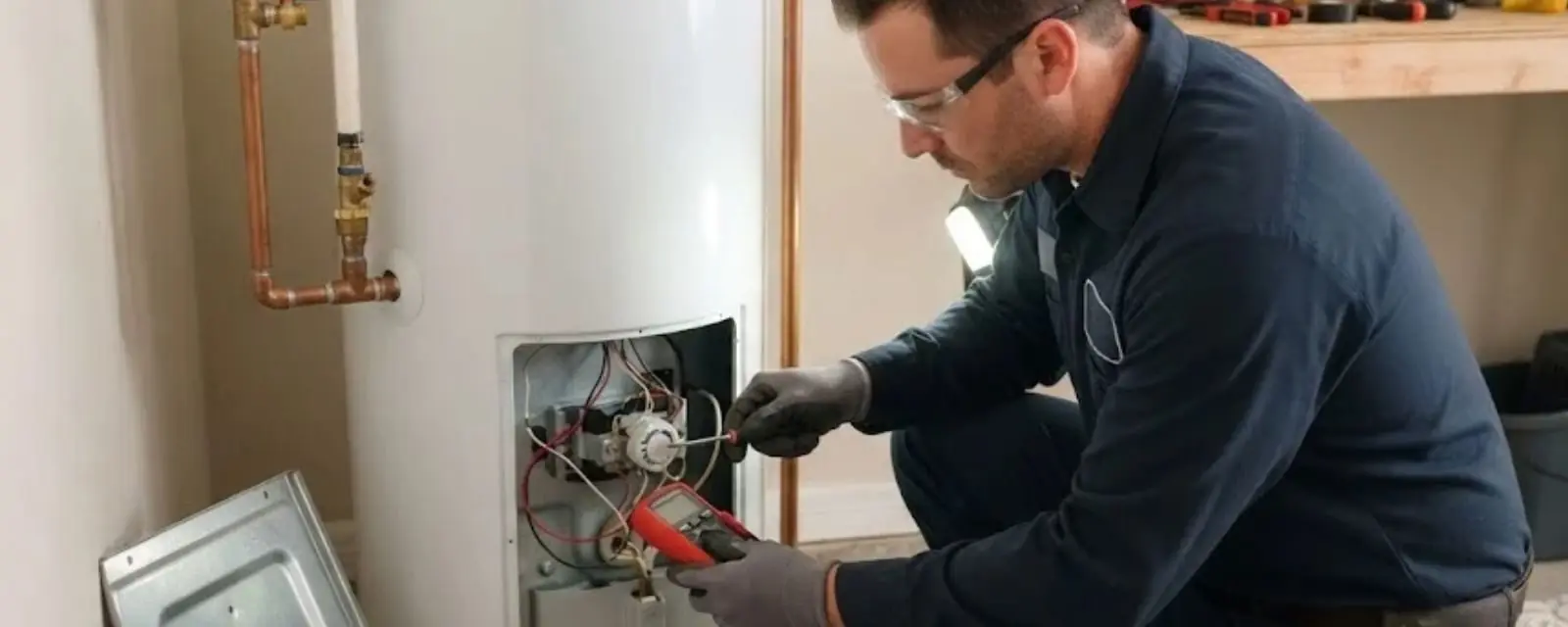
How an electric water heater element works
An electric tank has two heating elements, one near the top and one near the bottom, each controlled by a thermostat. The upper element heats the top of the tank first, then hands off to the lower one, which keeps the rest warm. Each element is a metal rod bent into a loop, screwed or bolted into the tank wall and wired to power.
When an element burns out, the tank can still heat, but only partly. If the lower element fails, you get a small supply of hot water that runs out fast. If the upper element fails, the water may be lukewarm throughout. If both fail, the water stays cold.
Signs an element has failed
Look for short hot showers, water that is warm but not hot, a tripped breaker, or a heater that hums but does not heat. Pop-and-sizzle noises can mean scale on the elements. A breaker that trips every time the heater runs may point to a shorted element.
Safety comes first. Turn the breaker off before opening any panel. Use a meter to confirm power is off. A multimeter can test element resistance, but you must disconnect the wires first. If you are not trained, call. Electric work inside a tank housing carries real shock risk, and a plumber or electrician should do it.
Remember that a bad thermostat, a tripped high-limit switch or a failed breaker can mimic a bad element. A plumber tests each part in order and does not swap blindly.
Problem right now?
Call to ask about help at your address.
Symptoms and likely cause
A quick guide, not a diagnosis.
| Symptom | Likely cause | Next step |
|---|---|---|
| Lukewarm water | Upper element or thermostat | Test both |
| Runs out fast | Lower element or sediment | Test, then flush |
| No hot water | Breaker, high-limit or both elements | Check power first |
| Popping noises | Scale on elements | Flush the tank |
Replacing an element
Replacement means shutting off power, closing the cold water, draining the tank below the element, unscrewing the old element and installing the new one with a new gasket. The new element must match the wattage and voltage and the mounting type, either screw-in or bolt-in. We also check the thermostat and the anode rod while the tank is open.
If the tank is old, leaking or heavily scaled, a new element may not be worth the cost. A tank near the end of its life will fail again soon, and an element repair does not stop a leak. Our water heater repair page explains how we decide, and replacement covers the other path.
Flushing sediment helps a heater last. In hard water, scale builds on elements and shortens their life, and a flush once a year is cheap insurance.
Hard water and element life
Scale insulates the element from the water and forces it to run hotter. It burns out sooner. Soft water or a regular flush helps. If you have scale problems, read our water softener page before buying equipment, and test your tap first. We serve Warrenville, where the city reports very hard water, and Wheaton, where it is much softer.
Testing the parts in the right order
A careful repair follows a sequence. First, confirm the breaker and the supply. Second, check the high-limit reset button, which trips when the tank overheats. Third, test the thermostats, which can fail in the on or off position. Fourth, test each element for resistance and for a short to the tank. Only then do you replace what failed.
Skipping the sequence leads to replacing the wrong part and paying twice. A good plumber shows you the failed part and explains why. A tank that has a rusty element flange, a wet insulation layer or a seam leak is a tank that needs replacement, not an element.
If the heater is more than about a decade old, ask about the anode rod and the tank condition while the unit is open.
Safety and sizing details
Elements are rated in watts and volts. Using the wrong rating can overload the circuit or fail to heat. The label on the tank gives the values. Low-density elements run cooler and last longer in hard water, though they cost more. Match the mounting style too: screw-in elements and bolt-in elements are not interchangeable.
Never run an element dry. A tank that is not full will burn out the element in moments. After replacement, fill the tank fully, bleed the air at a hot tap and only then restore power. Check for leaks at the gasket after the first heat cycle.
When to replace the whole heater instead
A tank that is ten or more years old, that leaks from the seam, or that has needed two repairs in a year is a poor bet for another element. The inside of the tank corrodes over time, and a new part does not stop it. Compare the cost of the repair with a share of the cost of a new heater and consider the energy savings of a modern unit.
If you decide to replace, our installation page explains sizing and venting. If the tank is leaking now, shut off the cold water and the power, and call us.
What to do first and safety steps for element trouble
Turn the heater's breaker off before anything else, and never open the element cover with power on. Do not touch wet wiring. If water is leaking from the tank, close the cold water valve above it and keep clear of the floor if it is wet near outlets. Let the tank cool before draining it, since the water can scald. Call a plumber if you are unsure about any step.
Sources and standards used on this page
The sources behind this guide on hot water heater elements are listed here. Plumbing in Illinois follows the Illinois Plumbing Code, found at 77 Ill. Adm. Code 890, and the Illinois Plumbing License Law, 225 ILCS 320. You can check any plumber's licence through the Illinois Department of Public Health lookup. Manufacturer instructions apply to every product we install.
What West Chicago homeowners should know locally
West Chicago's water comes from wells and is treated at a plant that removes iron and hardness. The city does not publish a hardness figure in the report we reviewed. Warrenville to the southeast reports 24 to 26 grains. Wheaton reports six to eight. The difference is a reminder that your own tap is the best test.
For utility questions, call West Chicago Public Works at (630) 293-2255. For permit questions on heater work, call Community Development at (630) 293-2200.
Questions homeowners ask
Only if you can safely turn off and verify power. Many homeowners call a plumber.
Many last years, but hard water and sediment can shorten life.
Usually, if the tank is sound. A leaking tank needs replacement.
A shorted element or wiring fault. Turn it off and call.