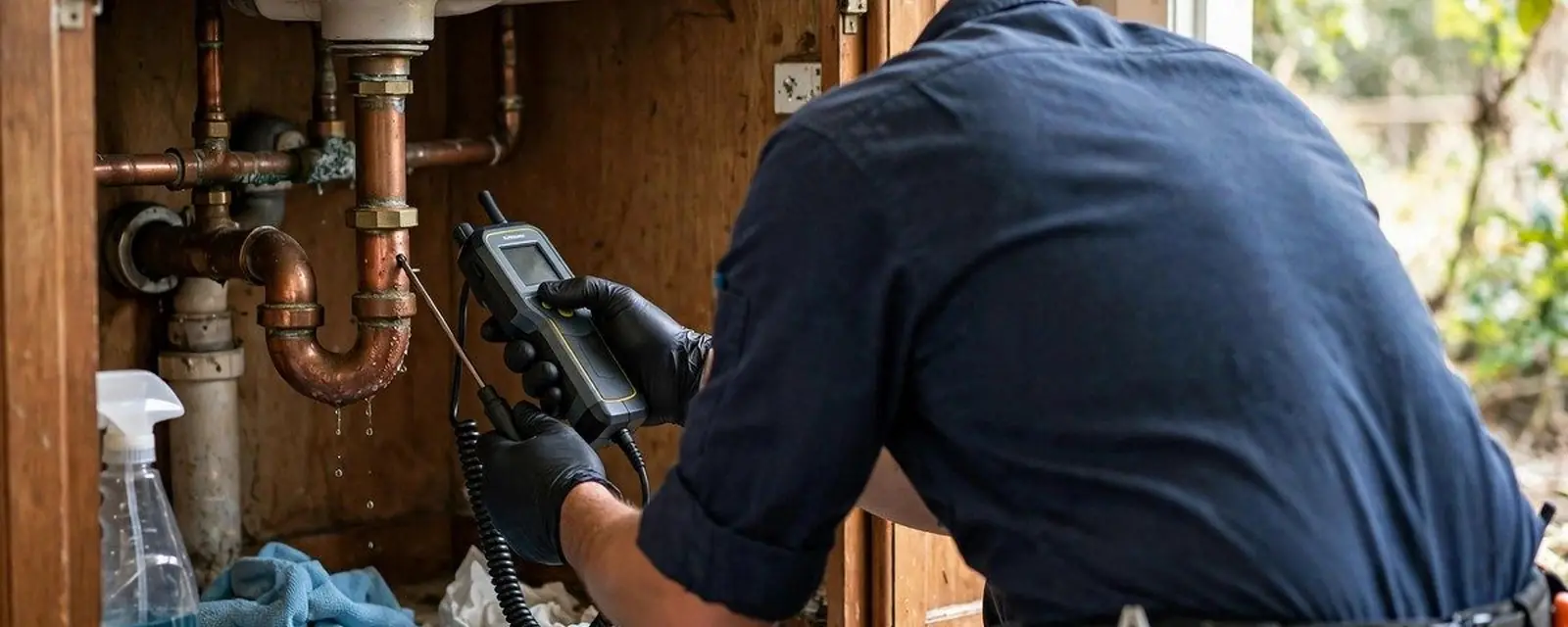
When a hidden leak is an emergency
A leak is an emergency when water is visibly spreading, when the meter spins with every fixture off, or when a ceiling is sagging. Call us.
Start at the main shutoff valve. Closing it stops the water in the house, and then you can watch your meter. If the dial still moves with the main closed, the leak is between the meter and the house. If it stops, the leak is inside. Tell us which. That one test saves a lot of searching.
Move belongings away from wet walls and floors, photograph the damage for your insurer, and turn off power to any outlet near a wet area if you can reach the panel dry. Do not open a bulging ceiling. Poke a small hole over a bucket only if the ceiling is holding a lot of water.
Start with the symptom: meter, bill, warm spot or stain
Most calls begin with a symptom, not a diagnosis. The meter keeps moving after everything is off. The water bill climbed and no one can explain it. A section of floor feels warm. A wall has a faint stain or a musty smell. Paint bubbles on a ceiling. Water pressure has dropped. Each symptom narrows the search.
A meter that moves with all fixtures off means a leak. The question is where.
A bill that climbs slowly often points to a toilet that runs, a drip at a fixture, or an irrigation line. A warm patch on a slab usually means a hot water line is leaking below. Check the toilet first by dropping food coloring in the tank and waiting fifteen minutes. If the color shows in the bowl, the flapper leaks, and toilet repair solves it.
When the usual suspects are ruled out, we bring tools.
Meter running with everything off?
Close the main and call.
How each tool narrows the search
We use several tools together because no single one finds everything.
| Tool | What it does | Best for |
|---|---|---|
| Acoustic listening gear | Hears the sound of escaping water in pipe | Slab leaks, pressurized lines |
| Thermal camera | Shows temperature differences behind surfaces | Hot water leaks, wet walls and ceilings |
| Moisture meter | Reads moisture inside drywall and wood | Confirming how far the water spread |
| Pressure test | Isolates a line and watches for a drop | Proving which line leaks |
| Line locator | Marks buried pipe path and depth | Yard and service line leaks |
Slab leaks and leaks under the house
A slab leak is a leak in a pipe that runs beneath or inside a concrete floor. Signs include a warm floor spot, the sound of running water when everything is off, damp carpet along a wall or a crack that was not there before. Many homes in West Chicago have a finished basement over a poured floor, and some have slabs on grade in additions or garages.
For homes with a crawlspace, the signs are different. The air feels damp, wood sits darker, and a musty smell rises in the closest room. We inspect the space, find the pipe that is wet, and tell you if the fix is a spliced section or a reroute around the damaged run.
Rerouting through the walls avoids breaking the slab, and sometimes it is the cleaner choice. If pipes throughout the house are in poor shape, repiping is worth comparing.
We will not guess. If the evidence is thin, we say so and run another test.
Ceiling and wall leaks, buried lines and irrigation
A ceiling stain below a bathroom is often a shower pan, a tub drain or a supply line. We trace it with thermal imaging and moisture mapping, then open only the spot that matters. Wall leaks follow the same pattern, and many behind a tub surround.
Buried leaks between the meter and the house are a separate category. Wet ground, a soft lawn patch, a dip in the yard or low pressure all point to the water service line. See water service line repair for the repair side.
If the leak is on an irrigation line, a pressure test on the system isolates it quickly. Pool and spa lines get one test at a time, since the plumbing is separate from the house.
Where a meter box in the yard is wet, the leak may be at the connection and not the house. Call us before you dig. Illinois requires a utility locate before excavation, so call 811 (JULIE) first.
Sources and standards used on this page
The sources behind this service page on leak detection are listed here. Our guidance follows the Illinois Plumbing Code, which is the state's plumbing standard, and the Illinois Plumbing License Law. Neither is a substitute for your city's own permit rules. Ask the building department first, and check the licence of anyone you hire at the Illinois Department of Public Health site.
What goes into the price of leak detection
The factors:
- Whether the leak is inside, under a slab or buried in the yard
- How many tools and how much time are needed
- Access, such as a finished basement or a locked utility room
- Written findings for an insurer or landlord
- Planned or urgent
Home insurance often covers water damage from a sudden leak and some policies pay for the cost of finding it, but many exclude the pipe itself and slow leaks. Call (630) 822-9290 with the symptom and we will give you a number.
Leak detection questions from West Chicago homeowners
Call (630) 822-9290 and ask about timing for your address.
Close your main shutoff and watch the meter. If it still moves, the leak is between the meter and the house. If it stops, the leak is inside. Tell us what you saw.
We use acoustic gear, thermal imaging, moisture meters and pressure tests. Together they point to a spot and we open only that.
Often yes. Acoustic tools and a line locator narrow it to a few feet, and we explain repair options such as a spot fix or a reroute.
Yes. We write findings for property managers and tenants. For larger sites, see commercial plumbing.
Not always. A running toilet and a faulty irrigation valve are common. We check the simple causes first.