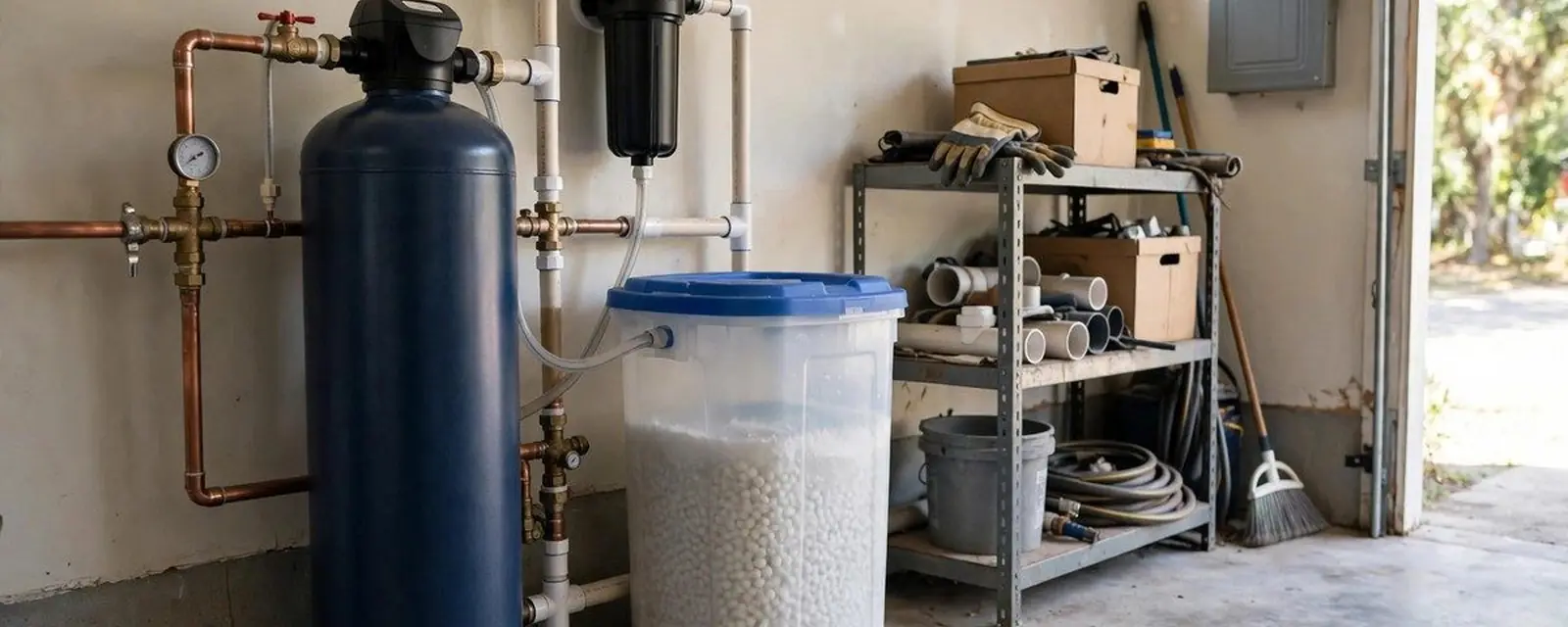
Start with your water, not a sales pitch
The City of West Chicago pumps groundwater from nine wells, and its treatment plant is designed to remove iron and hardness. The city's annual water quality report, available from Public Works at (630) 293-2255, does not publish a hardness figure in the 2024 report we reviewed, so we do not quote one. The honest first step is to test your tap.
A simple test kit or a lab test gives your hardness in grains per gallon. Compare it with what the city says and with what you see: spots on glass, scale on fixtures, soap that will not lather. If the numbers are low, a softener may not help. If they are high, a softener will.
Neighbors differ. Wheaton lists its water at six to eight grains per gallon, and Warrenville lists 24 to 26. Those cities use different sources from West Chicago, so those numbers are not yours.
Softener or filter: what each does
A softener swaps hardness minerals for sodium or potassium, which stops scale. A filter removes sediment, chlorine taste or specific contaminants depending on the media. They do different jobs, and a home may need one, both or neither.
Sediment filters protect fixtures. Carbon filters improve taste and smell. Reverse osmosis systems purify drinking water at a single tap. Whole-house systems treat everything that enters the home. We explain what each removes and what it leaves, and we do not oversell.
Many callers want a softener repaired or replaced because it stopped working. Common causes are a failed valve, empty brine tank or clogged injector. A six-year-old unit is often repairable.
Scale on fixtures?
Test your tap first, then call.
Choosing by problem
Match the equipment to what you see.
| What you notice | Probable cause | Equipment to consider |
|---|---|---|
| White crust on faucets | Hardness | Softener, after a test |
| Rusty stains | Iron | Iron filter or softener rated for iron |
| Chlorine taste or odor | Disinfectant | Carbon filter |
| Cloudy water | Sediment | Sediment filter |
| Bad drinking water taste | Various | Under-sink filter or RO |
Installation and the water heater
A softener installs on the main water line before the water heater, with a bypass valve, a drain connection and a power outlet. Hardness damages heaters, and soft water extends their life. See water heater installation and tankless water heater service if you are planning both.
Some municipalities set rules about softener discharge to the sewer. Ask West Chicago Community Development at (630) 293-2200 whether anything applies. Salt-based softeners add sodium to the water and some people on low-sodium diets use potassium instead.
Maintenance and what to watch for
A softener needs little attention but not none. Keep the brine tank at least a quarter full of salt, and break up any crust or bridge that forms. Clean the tank once a year, and check that the unit regenerates on schedule.
If you notice scale returning on fixtures, a salty taste or low pressure, call. The cause may be an exhausted resin bed, a clogged injector or a failed valve. Resin beds last for years but not forever, and a repair can be cheaper than replacement.
Bring your most recent water test to the visit. It gives us a baseline and tells us whether the system is doing its job.
Sources and standards used on this page
The sources behind this service page on water softener and filtration are listed here. The standard for plumbing work in this state is the Illinois Plumbing Code, published as Part 890 of Title 77 of the Illinois Administrative Code. Licensing falls under the Illinois Plumbing License Law, 225 ILCS 320, administered by the Illinois Department of Public Health. We also follow each maker's written guidelines.
Water facts come from the City of West Chicago water quality information, the Warrenville water page and the Wheaton water page.
What affects the price of softener or filter work
The factors:
- System type and capacity
- Water test results
- Installation access, bypass and drain
- Repair of an existing unit or replacement
- Salt or filter media costs over time
Insurance does not pay for treatment systems. Call (630) 822-9290 and we will help you decide whether you need one.
Water softener and filtration questions
Rarely. For leaks and failures our phone line is available.
Use a test kit or lab test on your tap. Compare it with what the city report says.
The city plant is designed to remove hardness. Test your own tap before buying anything.
Often yes. Failed valves and injectors are common.
Properly set, no. If it does, the unit needs service.