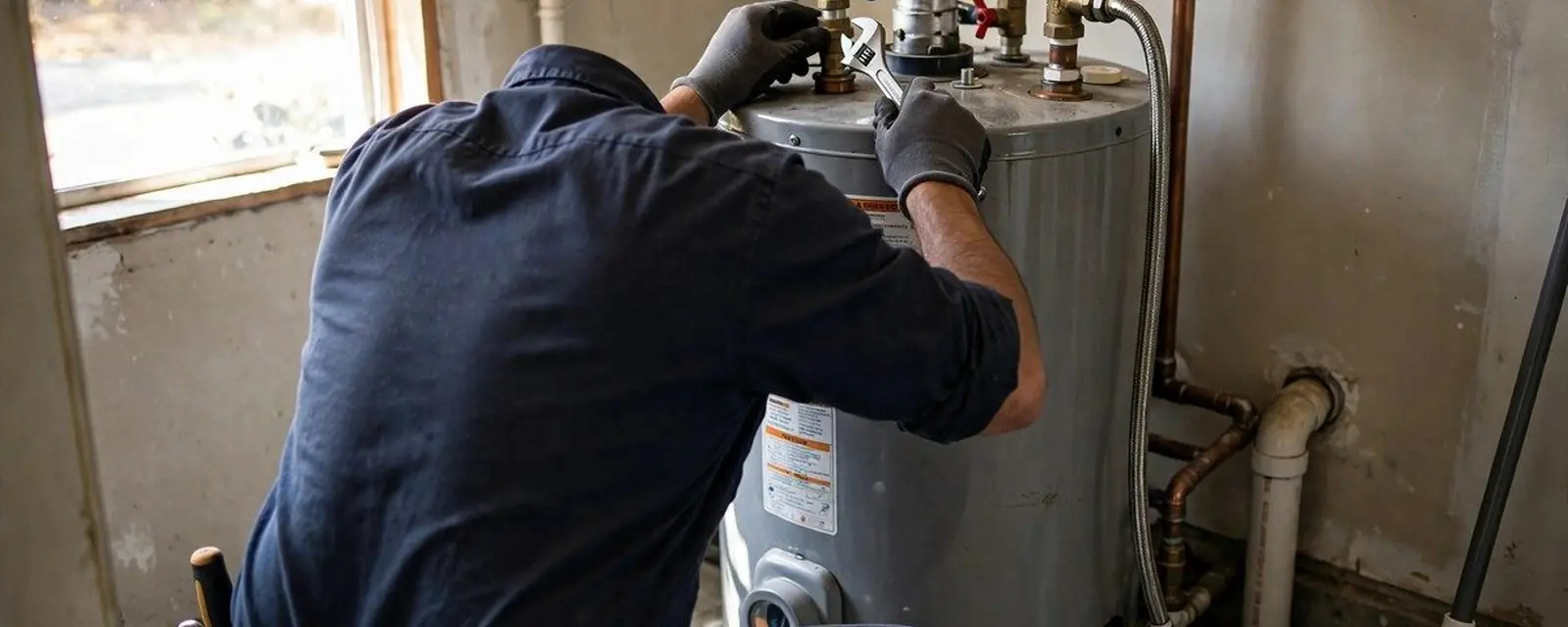
When a water heater problem is an emergency
A water heater is an emergency when it leaks, when it floods a utility room, or when you smell gas.
If you smell gas, leave the building first, then call 911 and your gas utility from outside. If your gas comes from Nicor Gas, its emergency line is 888.642.6748. Do not flip switches or look for the source. Gas heaters do not get a plumber until the building is cleared.
For a water leak, close the cold supply valve on top of the heater, then switch the heater off at the breaker or set the gas control to off if you can reach it safely. Put a bucket under a slow drip and move anything stored near the tank. If the tank itself is leaking, the water supply is the only thing to stop. Do not try to drain a very hot tank by yourself.
Why water heaters stop working
Most failures come from five parts. A gas heater with no hot water often has a thermocouple or igniter that has worn out. An electric heater with lukewarm water usually has a failed element or thermostat. A rumbling tank is sediment that has hardened at the bottom and is cooking under the burner or element. A leak at a fitting is a repair. A leak from the tank body is the end of the tank.
West Chicago pumps groundwater from nine deep wells, and the city treatment plant is designed to remove iron and hardness before the water reaches your tap. That helps tank life, but sediment and anode wear still happen on every tank over time. The anode rod is the part that sacrifices itself to protect the steel, and a worn rod is the reason many tanks fail from the inside.
Age matters. Tank heaters often last roughly eight to twelve years, so a heater past that mark with a new problem is usually a repair that buys little time. We will tell you plainly when replacement is cheaper than the repair.
Cold showers or a leaking tank?
Call to ask about help at your address.
Symptom, likely cause and what we do
Use this as a guide before you call. A plumber confirms the cause on site.
| Symptom | Likely cause | Typical fix |
|---|---|---|
| No hot water, gas heater | Pilot or thermocouple, igniter, gas control | Replace the failed part and test combustion |
| No hot water, electric | Tripped breaker, high limit switch, upper element | Test and replace the part |
| Lukewarm water that runs out fast | Lower element, sediment, dip tube | Replace element or flush the tank |
| Popping or rumbling noises | Hardened sediment on the tank floor | Flush, or replace if the tank is old |
| Water around the base | Fitting, valve or the tank itself | Tighten or replace a fitting. Tank leaks mean replacement |
A leaking water heater: repair or replace
Water pooling around a heater can come from a loose supply line, a failed temperature and pressure relief valve, a weeping drain valve or a rusted tank. The first three are inexpensive repairs. A rusted tank is not repairable. We check the top connections, the relief valve, the drain valve and the bottom jacket, and we tell you which one is leaking before we quote anything.
Heaters in a garage or an unfinished basement often sit near the slab or a floor drain, so a slow leak can run out of sight for weeks. If your water bill has crept up or the floor near the heater is damp, ask us about leak detection so the leak is confirmed to be the heater and not a pipe behind it.
The pressure relief valve is a safety device. Never cap or plug it. If it drips constantly, the cause is high pressure or a failing valve and we will test both.
Gas, electric and hybrid heaters
Gas heaters need an inspection of the burner, venting and draft in addition to the failed part. Electric heaters need a meter on the elements and thermostats. Hybrid heat pump heaters add a compressor and fan, and they repair like an appliance, so we check air filters, condensate drains and error codes first.
For hybrid, tank and electric units that are working but expensive to run, a repair will not change the bill. A different type might, and we explain the choices without pressure. See tankless water heaters if the tank has run out of capacity for your household.
Sources and standards used on this page
The sources behind this service page on water heater repair are listed here. Plumbing in Illinois follows the Illinois Plumbing Code, found at 77 Ill. Adm. Code 890, and the Illinois Plumbing License Law, 225 ILCS 320. You can check any plumber's licence through the Illinois Department of Public Health lookup. Manufacturer instructions apply to every product we install.
What affects the price of a water heater repair
We quote before we start. The factors:
- Which part failed and whether it is in stock
- Gas or electric, since the parts and safety checks differ
- Heater age and condition, which decides whether repair makes sense
- Access to the heater and fittings
- Planned or urgent
Home insurance may pay for water damage from a sudden leak but usually does not pay to replace the heater itself, and it often excludes slow leaks. Call (630) 822-9290 for a number based on your heater.
Water heater repair questions
Call (630) 822-9290 and ask about timing for your address.
Close the cold supply valve on the tank first. Then turn off the breaker or set the gas control to off if you can reach it safely, and call us.
Age is the biggest clue. A newer heater with a failed part is a repair. An older heater with rust or a tank leak is a replacement.
It can signal high pressure or a failing valve. Do not plug it. We test the pressure and replace the valve if needed.
Yes. We check airflow, filters, the condensate drain and error codes before opening the sealed system.