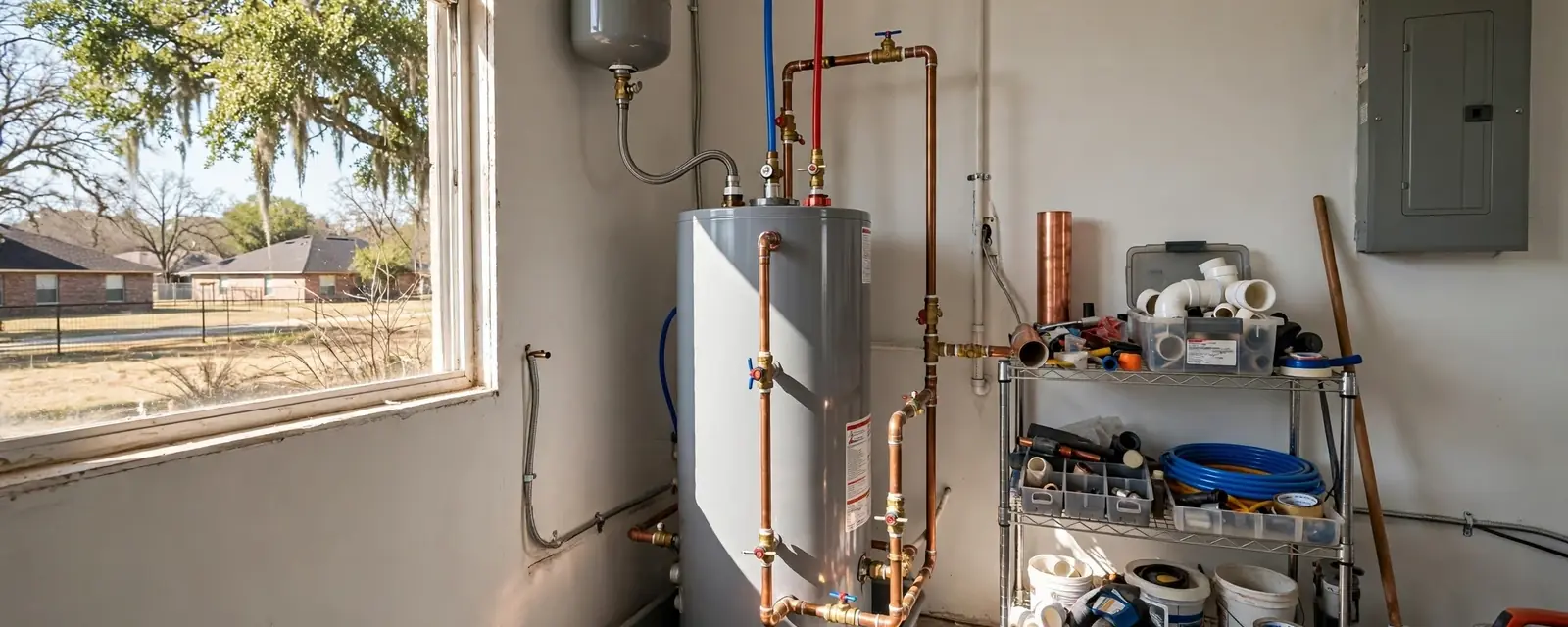
What a recirculation pump does
When you open a hot tap, the water in the pipe is cold. You wait for the hot water to travel from the heater to the fixture. In a long run, that wait can be a minute or more, and the cool water goes down the drain. A recirculation pump moves hot water through the pipe loop so that it is closer to hot when you open the tap.
The pump is small and sits near the water heater or under the farthest fixture. It runs on a timer, a temperature sensor or a button. Some homes have a dedicated return line that carries water back to the heater. Others use the cold line as the return, with a valve at the far fixture that bleeds a little warm water into the cold pipe.
Both approaches shorten the wait. They cost electricity and, in a full return loop, some extra heat loss from the pipes.
Dedicated return line or comfort system
A dedicated return line is the classic design. A second pipe runs from the farthest fixture back to the heater, and the pump pushes hot water around the loop. It works well but requires new pipe, so it is easiest when walls are open or in new construction.
A comfort system, sometimes called a retrofit kit, avoids the new pipe. A pump at the heater pushes hot water into the hot line, and a thermostatic valve at the farthest fixture opens to pass cooled water into the cold line, which returns it to the heater. The cold tap runs a little warm until the cycle ends, which some households dislike. It is cheaper to install in an existing house.
Ask a plumber which fits your pipe layout. If you are replacing the heater anyway, see water heater replacement. If you are adding to a tankless unit, many models have a built-in recirculation option, and our tankless page explains how they work.
Problem right now?
Call to ask about help at your address.
Choosing a recirculation setup
Match the system to the house.
| Option | Best for | Watch for |
|---|---|---|
| Dedicated return line | New builds and open walls | More pipe and cost |
| Comfort kit with valve | Existing homes | Warm cold-tap water |
| Timer control | Predictable schedules | Wasted heat off-schedule |
| Sensor or button control | Variable use | Sensors need power |
What installation involves
A plumber checks the heater, the pipe layout and the electrical supply. The pump needs power, so an outlet near the heater is often required. We install a check valve to stop backflow, an isolation valve for service and a means to set the schedule. In a gas heater, the vent and gas connections stay the same, but we confirm they are in good order while we work.
A recirculation system is not a fix for a tank that runs out of hot water, a failed dip tube or a bad thermostat. If your water is not hot enough, start with water heater repair. If hardness has scaled the pump or valves, a flush and, where it makes sense, a softener help. Hard water can shorten pump life, which is worth knowing in the area.
The pump should be rated for potable water, and brass or stainless bodies last better than cheaper materials in hard water.
Is a pump worth it?
It depends on the wait and the water you waste. A short run to a nearby bathroom may not justify the cost. A long run to a far bedroom suite or kitchen might. Count how many seconds you wait and how often. Ask whether anyone in the household gives up on morning showers because of the delay.
Run costs are modest if the pump runs on a timer. A pump that runs all day heats pipe loss for no reason. Ask for a timer or a sensor control, and set it to match when your family uses hot water. We also cover the site in Winfield and Geneva if you are outside West Chicago.
Questions to ask before you buy a pump
Ask how the pump will be controlled. A timer is simple and works for steady households. A temperature sensor runs the pump only when the loop is cool, which saves heat. A button at the fixture runs it on demand and uses the least power, though it requires someone to push it.
Ask how loud it is, what it is made of and whether the warranty covers installation. Ask what happens during a power outage, and whether the check valve will keep water from flowing the wrong way. Ask where the pump will sit and whether it needs an outlet that does not exist yet.
Finally, ask whether the real problem is the heater. A heater that is undersized or has failed elements will not fix itself with a pump. Fix the source first, then shorten the wait.
Wasted water and what it really costs
The water you run while waiting for hot water is real, but the amount varies by house. A short pipe run wastes little. A long run to a far bathroom wastes more. Time a few morning showers and estimate how many gallons go down the drain before the water warms up.
The pump uses electricity, and the pipes lose some heat while the loop runs. A good control keeps both small. Ask for a schedule that matches your mornings and evenings, and review it after a month.
Sources and standards used on this page
The sources behind this guide on water heater recirculation pump are listed here. For code questions, the reference is the Illinois Plumbing Code, 77 Ill. Adm. Code 890. For licence questions, it is the Illinois Plumbing License Law and the public lookup run by the Illinois Department of Public Health. Where a city has its own permit rules, the city's guidance comes first.
What West Chicago homeowners should know locally
West Chicago gets its water from nine wells in the Ironton-Galesville and Silurian dolomite aquifers, and the city treats it to remove iron and hardness. The city's annual water quality report is available from Public Works at (630) 293-2255. If you see scale on your recirculation pump or valves, test your own tap.
A new circuit or a change to gas piping can require a permit. Ask West Chicago Community Development at (630) 293-2200 before work begins.
Questions homeowners ask
Many last years, but hard water and constant running can shorten life.
A little, because it runs and moves heat. A timer limits the cost.
Not always. A comfort kit works in many existing homes.
Many models support it. Check the manual or ask us.