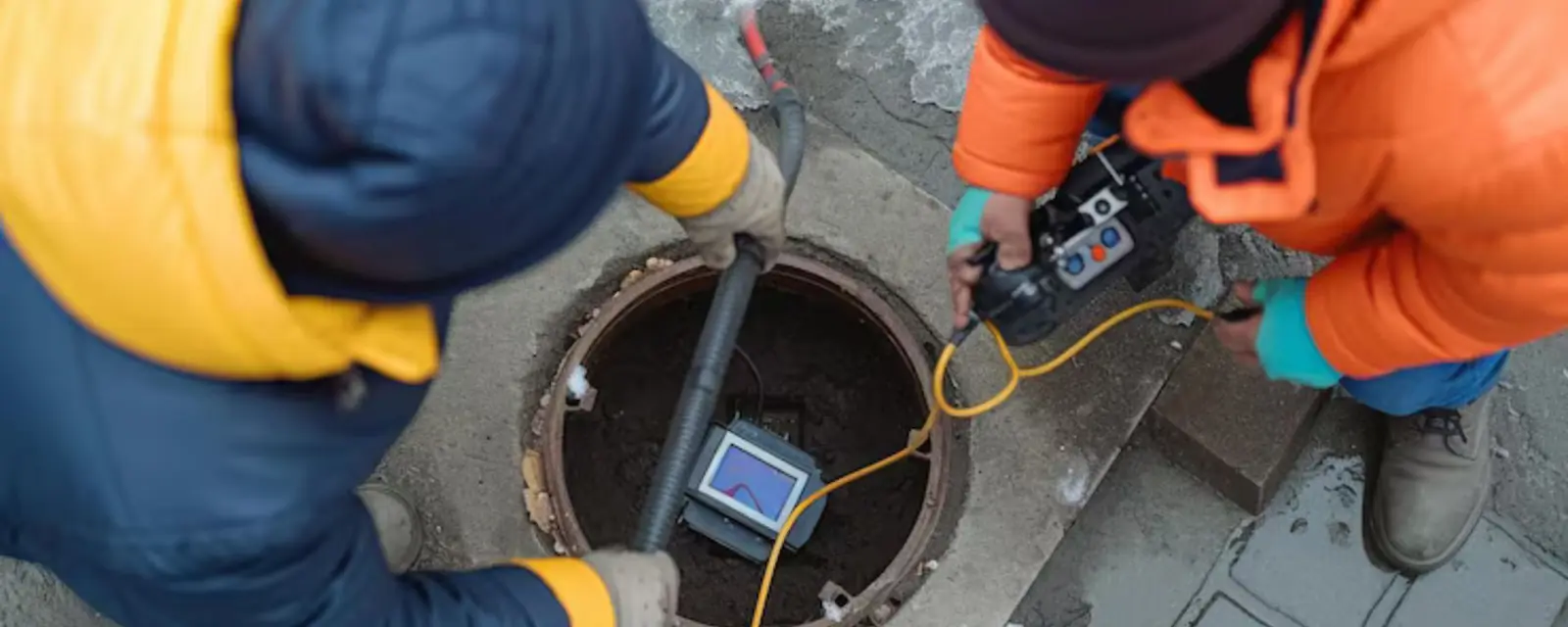
How a sewer line cracks
Sewer lines crack from age, ground movement, tree roots, heavy loads and poor installation. Clay pipe cracks along joints. Cast iron corrodes from the inside and can split. Plastic pipe can sag or crush if the soil under it settles. A crack can start small and grow each season as the soil freezes and thaws.
A cracked line leaks wastewater into the soil and lets groundwater and roots in. Roots clog the line, and the clog makes the next backup. Over time a small crack becomes a broken section.
Signs of a cracked line
Look for repeat clogs in the main, slow drains in several fixtures, sewage odor in the yard or basement, wet or sunken ground over the line and unexpectedly lush grass in a stripe. Water that backs into the lowest drain when you run the washer is a classic sign.
None of these is proof. A camera is. A plumber threads a small camera into the line, reads the footage and marks the location and depth of the damage. Our sewer inspection page explains what the camera shows, and sewer line cleaning covers clearing the line before a scope.
Problem right now?
Call to ask about help at your address.
Repair options for a cracked line
The right choice depends on the damage.
| Option | Best for | Trade-off |
|---|---|---|
| Spot repair | One short bad section | Needs excavation |
| Cured-in-place lining | Cracks and root entry along a run | Needs the line cleaned first |
| Pipe bursting | Long runs of failed pipe | Needs entry and exit pits |
| Full replacement | Collapsed or badly sagging pipe | Most digging |
Choosing a repair
A short, localized crack can often be fixed by digging to the spot and replacing a section. A long run with many cracks or joints may be a candidate for lining, where a resin-soaked sleeve is cured inside the old pipe to form a new pipe. Lining avoids most digging but does not fix a collapsed or bellied line.
Ask for the camera footage, the depth and the plan in writing. Ask what happens at connections and cleanouts. Ask about warranty terms. Our sewer line repair page explains how we compare options and prices before we start.
While you wait for the repair
Use less water. Avoid running the washer and dishwasher at the same time. Do not pour chemicals into the line. If a backup occurs, stop using water and call us. If sewage enters the home, keep children and pets away and ask about safe cleanup.
We serve Winfield and Geneva as well as West Chicago, and lines can be scoped for buyers before closing.
What a camera inspection tells you
A camera shows the pipe material, the joints, cracks, roots, offsets, bellies and the exact distance and depth of each problem. We record the footage and mark the surface with paint or a flag. You see what we see, and the decision becomes a comparison of real options.
A camera visit is also a good moment to ask about the rest of the line. A repair at one spot may leave other weak spots. Ask for a plan that covers the whole run. If the line is in good shape except for one crack, a spot repair may be enough. If it is in poor shape throughout, lining or replacement may save money in the long run.
Costs, warranties and questions to ask
Costs depend on the length, the depth, the soil, the surface above the pipe and the access. A line under a driveway or a patio costs more to reach than one under a lawn. A deep line needs more shoring. Ask for the scope in writing, including who handles restoration of the lawn, concrete or landscaping.
Ask about warranties on the repair. A spot repair and a liner carry different terms. Ask whether the work needs a city inspection and who arranges it. Ask whether the plumber will provide the footage after the repair, which proves the new section is sound.
Roots, bellies and other causes
Cracks are not the only sewer defect. A belly is a low spot that holds water and solids. An offset joint is a step where two pipes no longer line up. A collapse is a total failure. Roots can enter through any of these. A camera sorts them out.
A belly may need replacement. Lining cannot lift a low spot. An offset may be handled with a spot repair. Roots can be cut with a jetter or a cutter, then the opening sealed. Knowing which defect you have prevents paying for the wrong fix. Ask your plumber to name each defect in the footage.
Sources and standards used on this page
The sources behind this guide on sewer line crack repair are listed here. Our guidance follows the Illinois Plumbing Code, which is the state's plumbing standard, and the Illinois Plumbing License Law. Neither is a substitute for your city's own permit rules. Ask the building department first, and check the licence of anyone you hire at the Illinois Department of Public Health site.
What West Chicago homeowners should know locally
Excavation in a yard may need a permit and a utility locate before digging. Illinois has a one-call system for locating buried utilities, and your plumber should arrange it. Ask West Chicago Community Development at (630) 293-2200 about permits for sewer work and inspections.
West Chicago Public Works, at (630) 293-2255, handles the city sewer mains. If the problem is in the street, it is the city's. If it is on your property, it is yours.
Questions homeowners ask
Sometimes, with lining. It depends on the damage.
A camera shows where it is and your plumber can tell which side.
Often not for wear. Ask about sewer line coverage.
A spot repair can take a day. Lining or replacement can take longer.