Signs your main sewer line needs emergency cleaning
The clearest sign is a backup in the lowest drain in the house. In many West Chicago homes that is a basement floor drain or a basement bathroom. If it fills when you run a washer upstairs, the main is blocked and your fixtures are competing for the same short path to the street.
Call us and describe what you see. Until help arrives, do not run water, do not flush, and keep people out of the affected room. If the cleanout cap in your basement or yard is accessible, leave it closed unless we ask you to open it.
Sewage on the floor is a health hazard. Floors, drywall and carpet that stay wet for long can grow mold, so tell your insurer early and photograph the affected area before cleanup.
Where the blockage usually forms
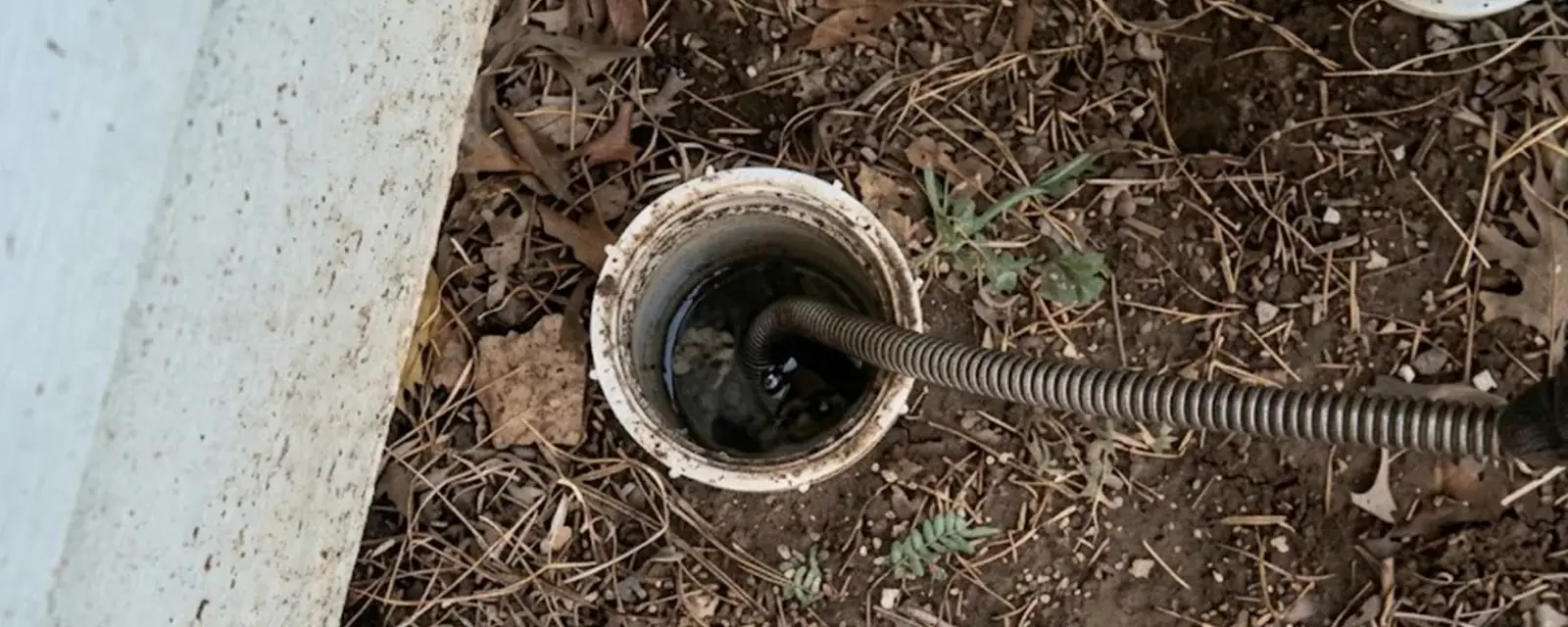
A main sewer line is the pipe between your foundation wall and the connection to the public sewer under the street. Blockages gather at three places. The first is just past the foundation where the pipe makes its turn. The second is at any joint where roots have found a seam. The third is at a low spot, called a belly, where water settles and solids collect.
A cable works for the first two. A belly is a repair problem, because cleaning it only restores flow until the next heavy load. After cleaning we pour water through the line and watch it drain, and if it holds at a low point we say so plainly instead of calling the job done.
Homes with a sewer lateral that serves a finished basement with a bathroom feel the failure first, because the basement fixtures sit lowest. If that describes your house, ask us about a backwater valve during the visit. Local permit requirements vary, so ask the West Chicago Community Development Department at (630) 293-2200 before any change to the line.
Sewage on the floor?
Keep out of the room and stop using water.
How a sewer line cleaning visit goes
We follow the same four steps on every main line call.
- 1Locate
We find the cleanout or the closest access to the main.
- 2Clear
A drum cable or jetter removes the blockage.
- 3Check
We run water and watch the flow, and add a camera if the cause is unclear.
- 4Report
You hear what we found and whether repair makes sense.
Cleaning, inspecting or repairing: how to decide
Cleaning is the right call when a line clogged once and the pipe is sound. Inspection is the right call when a line clogged twice. Repair is the right call when the camera shows roots, a belly or a break. Paying for a third cleaning without looking is the expensive choice.
If you want the look first, sewer camera inspection shows the pipe on video. If the problem is grease and scale, hydro jetting cleans the wall instead of poking through it. If water is coming up through a floor drain with no obvious cause, our drain cleaning team starts at the branch and works toward the main.
The question we hear most is whether the village or the homeowner owns the pipe. In most places the homeowner owns the lateral up to the connection, but this depends on the city. Ask the West Chicago Public Works Department at (630) 293-2255 before you assume.
Sources and standards used on this page
The sources behind this service page on sewer line cleaning are listed here. Two state sources frame this work. The Illinois Plumbing Code sets the technical rules, and the Illinois Plumbing License Law says who may do it. Both are public, and the Illinois Department of Public Health keeps the licence lookup. Local rules, where they apply, come from your own city.
What goes into the price
We weigh:
- Whether a cleanout is present or a fixture has to be pulled to reach the line
- Length of the line and how far the blockage sits
- Cable or jetter, depending on what the line holds
- Whether a camera pass is needed before or after
- Planned or urgent
Standard homeowner coverage usually pays for sudden water damage but not for the line itself, and sewer backup coverage is generally an optional endorsement. Read your policy, then call (630) 822-9290 for a number based on your line.
Main sewer line cleaning FAQs
Call (630) 822-9290 and ask about timing for your address.
A single slow fixture points to a branch. If a basement floor drain backs up or two or more fixtures slow together, the main is the likely culprit.
Small hand tools reach a few feet. A main line needs a drum cable. If you have tried and failed, tell us, since it helps us pick a tool.
It removes them for now. Roots return through the same joint until it is repaired. See sewer line repair.
Take photos of the standing water, the affected floors and any damaged belongings before cleanup. Do it from outside the water if you can.