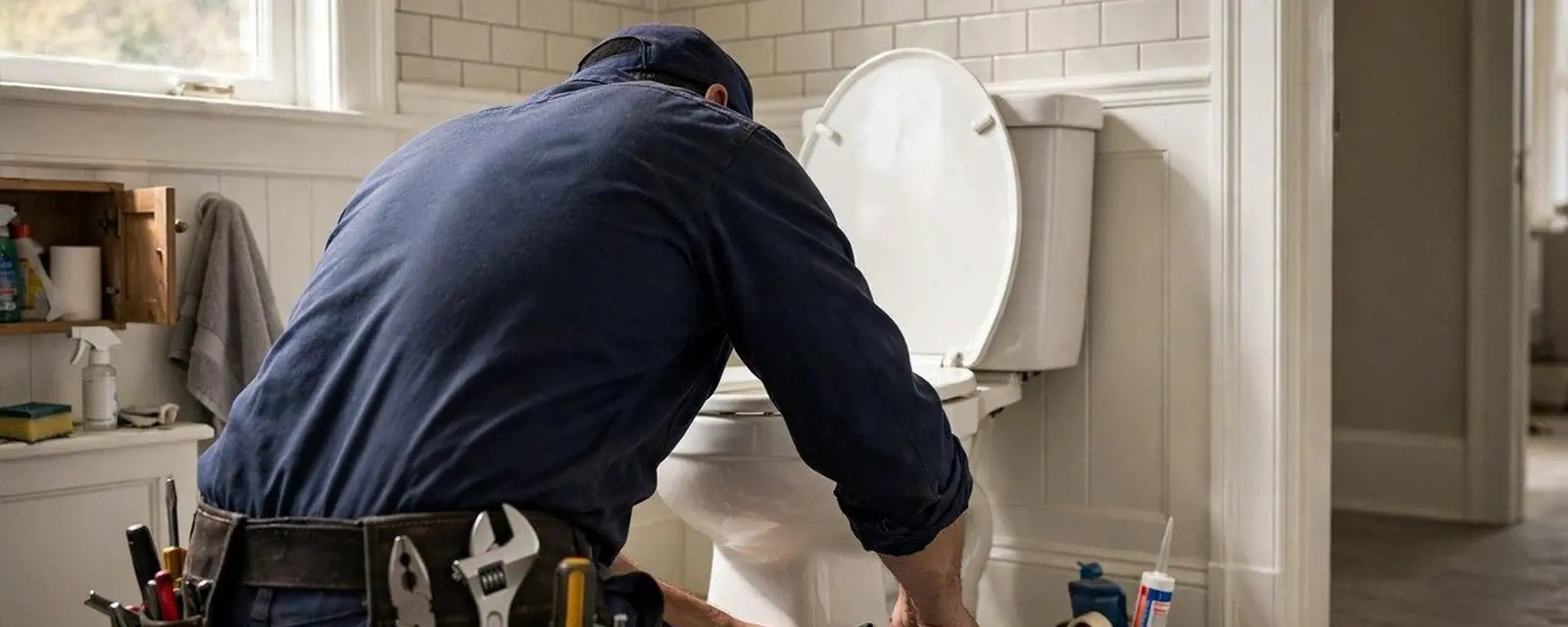
When a toilet problem is an emergency
A toilet is an emergency when it overflows, leaks onto a ceiling below or will not stop running water. Call us.
If the bowl is rising, lift the tank lid and push the flapper down, or close the supply valve behind the toilet by turning it clockwise until it stops. That stops new water. Do not flush again. If water is spreading, shut the main and call us. Put towels along the base and keep children out of the room.
A toilet that overflows repeatedly may be telling you the main line is blocked. Check whether the tub or a basement drain gurgles when you flush. If so, see drain cleaning, because a plunger will not fix a main line.
Why toilets fail
A running toilet is usually a worn flapper, a fill valve that no longer shuts off, or a chain that sticks. These are inexpensive parts, and a toilet that runs constantly wastes a surprising amount of water. A leak at the base is usually the wax ring or a loose closet bolt. A rocking toilet means the flange is damaged or the floor is not flat.
Clogs are a different problem. A first clog clears with a plunger or a closet auger. A toilet that clogs every few days has a deeper issue, either a partial blockage in the line, a vent problem or a low flow model that no longer suits the household.
West Chicago's treated well water is low in iron and hardness at the plant, which helps fixtures last, but old tank parts still wear. We replace the entire fill and flush assembly when parts are tired, because patching one piece often brings the next failure in a month.
Toilet will not stop running?
Call to ask about help at your address.
Toilet symptoms and fixes
Most are quick repairs.
| Symptom | Likely cause | Fix |
|---|---|---|
| Runs on and off | Flapper or fill valve | Replace the valve and flapper set |
| Water at the base | Wax ring or closet bolts | Pull toilet, reset on a new ring and flange check |
| Rocks when sat on | Loose bolts or broken flange | Repair flange, reset toilet |
| Weak flush | Clogged rim jets or siphon | Clean the passages |
| Clogs repeatedly | Line or vent issue | Cable the line, camera if needed |
Installing a new toilet
A new toilet is a quick install when the flange is sound. We remove the old unit, check and repair the flange, set a new wax ring or similar seal, level the bowl, connect a new supply line and test the flush.
Older homes may need a flange repair ring where the old flange has cracked. If the floor under the toilet is soft, we stop and tell you, since the toilet will not stay set on a rotted subfloor.
For a full bathroom project, plumbing installation covers rough-in and fixtures together. If water is stained on the ceiling below the toilet, our leak detection plumber can confirm the source before the floor opens.
What to do while a toilet is overflowing
Do not flush again. Lift the tank lid and push the flapper down, or turn the supply valve behind the toilet clockwise to stop new water. Put towels around the base, keep children out and wear gloves if the water is dirty, since overflow water can carry germs. If water is reaching a ceiling below or an outlet, switch off the power to that area and call us.
Sources and standards used on this page
The sources behind this service page on toilet repair and installation are listed here. Our guidance follows the Illinois Plumbing Code, which is the state's plumbing standard, and the Illinois Plumbing License Law. Neither is a substitute for your city's own permit rules. Ask the building department first, and check the licence of anyone you hire at the Illinois Department of Public Health site.
What affects the price of toilet repair
The factors:
- Repair or replacement, and which parts are needed
- Condition of the flange and floor
- Toilet model if replacing
- Whether a clog needs cable or camera work
- Urgent problem
Insurance often covers water damage from a sudden overflow but not the toilet itself. Call (630) 822-9290 and describe what you see.
Toilet repair questions
Call (630) 822-9290 and ask about timing for your address.
Close the supply valve behind the toilet, lift the tank lid and push the flapper down, and do not flush again.
Usually a failed wax ring or loose bolts. It can also be condensation. A dry towel test after wiping tells the difference.
If the porcelain is sound, yes. If it is cracked or clogs often, replacement is better.
Yes. We set and test customer-supplied toilets and tell you if the flange needs repair.