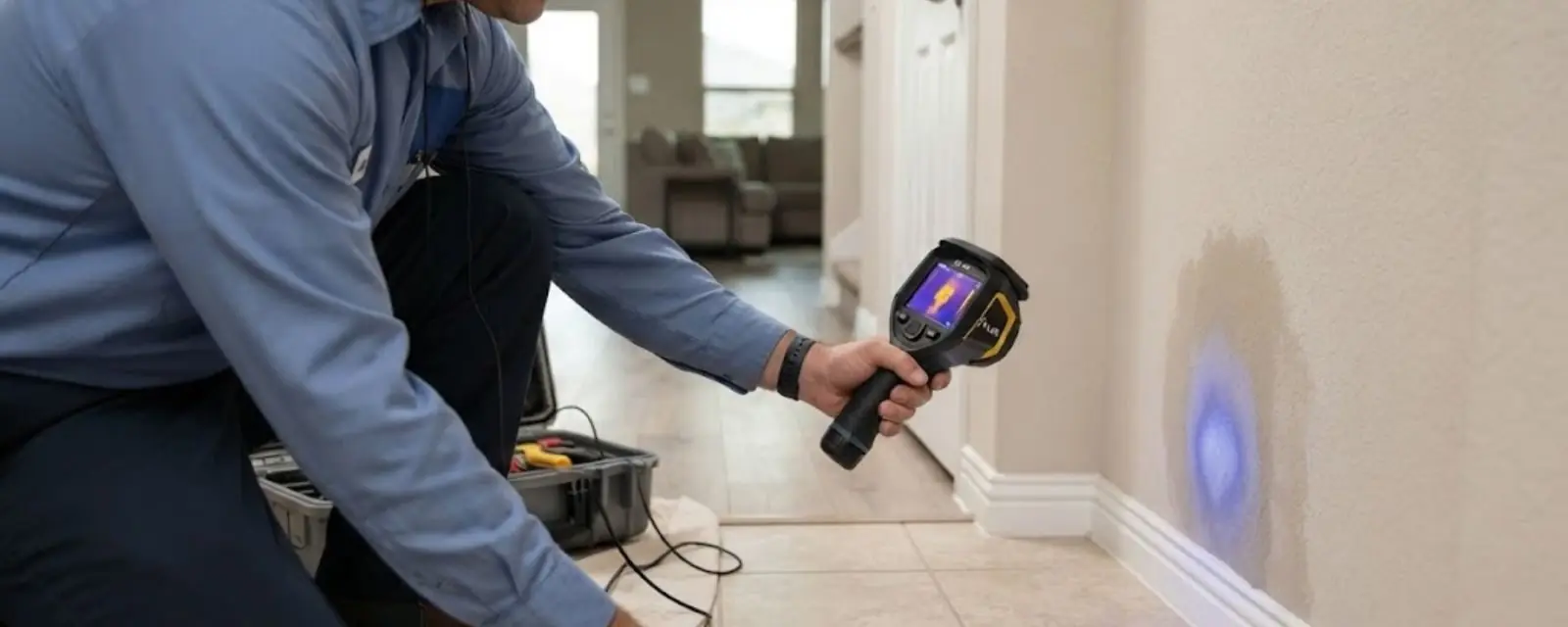
What electronic leak detection means
The phrase covers a group of tools that find leaks without tearing out walls. A leak in a pressurized pipe makes a sound, leaves heat or cold behind and wets the material around it. Each tool senses one of those signs. A trained plumber combines them with the home's layout to mark where the leak is.
It is not magic. It is a search that narrows with each reading. The tools tell you where to look, and the plumber confirms before cutting. That keeps the damage to a small access hole.
The main tools
Acoustic listening uses sensitive microphones on the floor, wall or pipe to hear the hiss of a leak. Different materials carry sound differently, so the plumber reads the signal and the context. A noisy house or a flowing sewer can mask it.
Thermal imaging cameras show temperature differences on a surface, which helps find a hot water leak under a floor or a wet wall behind a finish. A moisture meter reads dampness in drywall, wood and concrete. Tracer gas, a harmless mix, is pushed into an emptied pipe and sniffed above to find the point it escapes. Pressure testing isolates sections of line to see which one drops.
Problem right now?
Call to ask about help at your address.
Which tool for which problem
A plumber picks based on the situation.
| Situation | Tool | Limit |
|---|---|---|
| Hissing in a wall | Acoustic | Noise masks it |
| Warm floor | Thermal camera | Needs a temperature difference |
| Stain with no source | Moisture meter | Shows wet, not where from |
| Slab or buried line | Tracer gas or pressure test | Line must be isolated |
| Meter moves with all off | Meter test | Does not find the spot |
What happens during a visit
We start with a meter check. With all fixtures off, we watch the meter. If it moves, a leak exists on the house side. We interview you about symptoms, then isolate the supply, test sections and use the tools above. When we find the likely spot, we show you the reading and explain the options.
Our leak detection page gives the full process, and water service line covers a leak between the street and the house. If the leak is a drain, a camera inspection is the right tool.
What to do first
Note where you see stains, damp spots, warm floors or noises. Find the meter and the main shutoff. Turn off all water and appliances so the meter test is clean. If water is spreading, close the main and call us.
Take photos and the date of your last water bill. If a bill jumped, a copy helps. This site also covers Wheaton and Warrenville, where older homes often hide leaks.
Signs of a hidden leak
Hidden leaks reveal themselves in small ways. The water bill rises without a change in habits. You hear running water when nothing is on. A wall or ceiling stain grows. A floor feels warm underfoot. A musty smell lingers in a closet or cabinet. Paint bubbles. The meter dial spins with all fixtures off.
Check the toilet first. Add food coloring to the tank, wait fifteen minutes and see if color appears in the bowl. A running toilet is the most common cause of a high bill and is cheap to fix. See toilet repair. If the toilet is fine and the meter still moves, a hidden leak is likely.
Choosing a company and what to ask
Ask what tools the plumber will use and how they will confirm the leak before cutting. Ask for a plain price for detection and a separate price for repair, since detection alone may be all you need for an insurance claim. Ask for a written report and photos that show the readings.
Ask whether the plumber will repair the leak or only find it. A company that finds and fixes saves a second visit. Ask about the access hole, who patches the wall and what is left for you or a contractor. Keep the report for insurance and for any future sale.
Insurance and documentation
If a hidden leak has damaged a ceiling, floor or wall, insurance questions follow. Many policies cover sudden and accidental water damage but not long-term seepage or the cost of finding the source. Read the language on tear-out and access, since some policies pay to reach the pipe and some do not.
Photograph the damage before anything is touched. Keep the detection report, the repair invoice and your water bills. Call your insurer early, and ask what they need from the plumber. A clear report with readings and photos speeds a claim and shows the leak was found by a proper method.
Leak prevention after the repair
Once the leak is fixed, reduce the chance of another. Know where your main shutoff is and test it. Replace old supply hoses on washers and toilets, since rubber hoses age and burst. Check under sinks twice a year. Consider a smart shutoff or leak sensors near the water heater, washer and sump. These devices warn you early and some can close the main.
Sources and standards used on this page
The sources behind this guide on electronic water leak detection are listed here. For code questions, the reference is the Illinois Plumbing Code, 77 Ill. Adm. Code 890. For licence questions, it is the Illinois Plumbing License Law and the public lookup run by the Illinois Department of Public Health. Where a city has its own permit rules, the city's guidance comes first.
What West Chicago homeowners should know locally
West Chicago Public Works, at (630) 293-2255, can answer questions about the meter, the service connection and billing. If a leak is on the city side of the meter, the city is responsible, not you. Your plumber can tell which side it is on.
Permits for repairs vary. West Chicago Community Development at (630) 293-2200 can tell you if a repair that opens a wall or digs in the yard needs one.
Questions homeowners ask
No. It reads from the surface, and only the leak spot is opened.
Often yes, with acoustic, thermal and pressure methods.
No. Roof, window and condensation problems can mimic it.
It narrows the area. A plumber confirms before cutting.